Free FAA Part 107 practice questions with answers
Twenty-five original, source-verified FAA Part 107 questions with full answers and rationale below, free to read, no account required. A new set every day.
Question 1
Under 14 CFR 89.110(a)(1), from what point in a flight must a standard remote identification unmanned aircraft broadcast its remote identification message elements?
- From takeoff to shutdownCorrect
- Only while above 400 feet AGL
- Only when operating within controlled airspace
Why: Section 89.110(a)(1) requires a person operating a standard remote identification unmanned aircraft to ensure that the aircraft broadcasts the message elements of 89.305 from takeoff to shutdown; the broadcast duty is not limited to altitudes above 400 feet AGL and is not limited to controlled airspace, since remote ID applies regardless of airspace class. Primary reference: 14 CFR 89.110(a)(1), Operation of standard remote identification unmanned aircraft.
Question 2
A remote pilot operates a Category 4 small unmanned aircraft in sustained flight over an open-air assembly of spectators. Under 14 CFR 107.140(a)(2), what additional requirement applies?
- The operation must meet the requirements of either 89.110 or 89.115(a) of the Remote Identification ruleCorrect
- No additional requirement applies, since every Category 4 aircraft already holds a part 21 airworthiness certificate
- The operation must be conducted only within a closed or restricted access site with everyone on notice
Why: Section 107.140(a)(2) prohibits a remote pilot in command from operating a Category 4 small unmanned aircraft in sustained flight over open-air assemblies of human beings unless the operation meets the requirements of either 89.110 or 89.115(a), the same Remote Identification condition that applies to Category 1 and 2. The airworthiness certificate required for Category 4 eligibility does not substitute for this condition, and the closed or restricted access site provision belongs to the moving vehicle rule in 107.145, not this one. Primary reference: 14 CFR 107.140(a)(2), Category 4 operations.
Question 3
A remote pilot in command wants to fly a small unmanned aircraft within the surface area of Class D airspace surrounding an airport. Under 14 CFR 107.41, what must the remote pilot in command obtain first?
- A waiver under 107.200, regardless of any authorization process
- Nothing, because Class D airspace is treated the same as Class G for small UAS
- Prior authorization from air traffic controlCorrect
Why: Prohibits operating in Class B, C, or D airspace, or the surface area of Class E airspace designated for an airport, without prior ATC authorization. The other listed options restate adjacent or superseded rules and do not match the cited text, so they are incorrect under the current regulation. Primary reference: 14 CFR 107.41, Operation in certain airspace. Cross-reference: AC 107-2A, paragraph 5.10, p. 5-7.
Question 4
As part of a preflight check before an automated operation, what must the remote pilot verify about the small UAS's GPS?
- That it has acquired GPS location from the minimum number of satellites specified by the manufacturerCorrect
- That the GPS receiver is disabled entirely in order to prevent interference with the control link itself
- That the GPS antenna has been physically removed for the duration of the flight
Why: Among the recommended preflight inspection items, the remote pilot should verify communication with the small unmanned aircraft and confirm that it has acquired GPS location from the minimum number of satellites specified by the manufacturer, since an inadequate satellite lock can degrade position hold and increase the risk of loss of control. Disabling or removing the GPS equipment would eliminate the very function the inspection is meant to confirm. Primary reference: AC 107-2A, paragraph 7.3.4, p. 7-3, Preflight Inspection Items.
Question 5
A remote pilot in command plans a small UAS flight entirely during daylight hours, with no part of the flight occurring during civil twilight or at night. Under 14 CFR 107.29, must the aircraft have illuminated anti-collision lighting?
- Yes, but only above 400 feet AGL
- No, anti-collision lighting is required only during civil twilight and at nightCorrect
- Yes, anti-collision lighting is required for every part 107 flight, a superseded figure
Why: Requires anti-collision lighting for operations at night and during civil twilight, but does not impose that requirement on daylight operations. The other listed options restate adjacent or superseded rules and do not match the cited text, so they are incorrect under the current regulation. Primary reference: 14 CFR 107.29(a)-(b), Operation at night. Cross-reference: AC 107-2A, paragraph 5.7.2.2, p. 5-4.
You have seen 5 of 25. Create a free account for scored practice, timing, and the full bank of 506 questions for this exam.
Create a free account →Question 6
Under 14 CFR 107.31(a)(2), besides knowing the aircraft's location, what else must the remote pilot in command be able to determine by unaided visual contact?
- The unmanned aircraft's attitude, altitude, and direction of flightCorrect
- The unmanned aircraft's remaining battery percentage as shown on the ground control station display
- The unmanned aircraft's precise groundspeed in knots as reported by its onboard GPS module
Why: Paragraph (a)(2) requires the remote pilot in command, visual observer, and person manipulating the controls to determine the unmanned aircraft's attitude, altitude, and direction of flight by unaided vision. Battery percentage and a precise groundspeed figure are not among the things (a)(2) requires visual contact to determine; those are read from instruments rather than from watching the aircraft. Primary reference: 14 CFR 107.31(a)(2), Visual line of sight aircraft operation.
Question 7
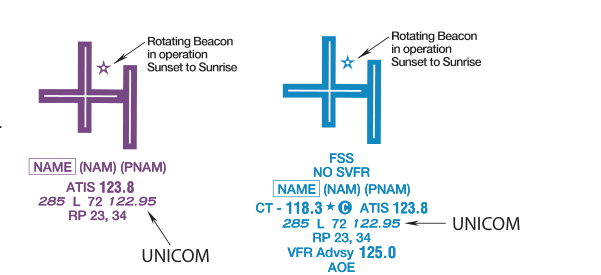
Refer to the figure, two airport data groupings, both centered on the same rotating-beacon cross symbol: one printed in magenta and one printed in blue. What does the color of the airport data, magenta versus blue, tell a remote pilot about that airport?
- Blue indicates the airport has fuel available; magenta indicates no fuel services
- Blue indicates the airport has an operating control tower; magenta indicates it does notCorrect
- Blue indicates the airport is open to public use for any aircraft; magenta indicates it is a private-use airport
Why: The Chart User's Guide states that airports with control towers and their related data are shown in blue, while all other airports and their related data are shown in magenta, which is exactly the color difference between the two groupings in the figure. Public-versus-private use is instead shown by the "Pvt" notation after an airport's name, and fuel availability by a separate facility symbol, so neither distractor matches what the color itself encodes. Primary reference: Aeronautical Chart User's Guide, edition 2026-07-09, Airport Data Grouping legend, p. 24.
Question 8
A remote pilot needs to spell an aircraft identifier for ATC. What should the pilot use?
- The ICAO phonetic alphabet adopted for radio communicationsCorrect
- Any informal set of words the pilot personally prefers instead of a standardized alphabet
- Morse code tones transmitted over the voice frequency in place of spoken letters
Why: ICAO has adopted a phonetic alphabet that pilots should use when communicating with ATC to identify their aircraft clearly, since plain letters are easily confused over a noisy radio link. An informal personal vocabulary defeats the purpose of a standard the whole system relies on, and Morse code tones are not used for routine voice identification. Primary reference: Pilot's Handbook of Aeronautical Knowledge, p. 14-23, Figure 14-41, Phonetic alphabet. Cross-reference: Remote Pilot Study Guide, p. 39, Figure 7-1.
Question 9
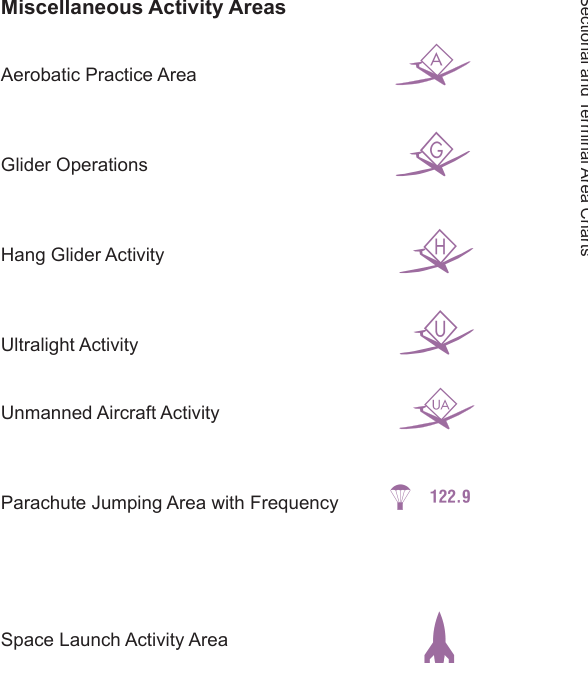
Refer to the figure. The parachute jumping symbol is shown next to the frequency "122.9." What is the significance of a frequency printed beside this symbol?
- It is the Mode C transponder code a manned aircraft must set to transit the area
- It is the frequency a remote pilot must use under 14 CFR 107.41 to request ATC authorization near the site
- It is the frequency used for coordination or monitoring of parachute jump operations at that siteCorrect
Why: The legend names this entry "Parachute Jumping Area with Frequency," so the number beside the symbol is the frequency associated with that jump activity, not a transponder code (which is a four-digit squawk code, not a VHF frequency like 122.9) and not an ATC authorization frequency under 107.41, which is obtained through LAANC or DroneZone rather than by calling a published jump frequency. Primary reference: Aeronautical Chart User's Guide, edition 2026-07-09, Miscellaneous Activity Areas legend, p. 31. Cross-reference: Pilot's Handbook of Aeronautical Knowledge, FAA-H-8083-25C, Parachute jump operations, p. 15-6.
Question 10
Two certificated remote pilots want to transfer the remote pilot in command designation to each other partway through a single small UAS flight. Under 14 CFR 107.19(a) and AC 107-2A paragraph 5.2.1.1, what must be true for the transfer to be permitted?
- Both pilots can maintain visual line of sight of the aircraft, and the transfer is positively communicated between themCorrect
- The aircraft is landed and the flight is fully paused before the designation changes hands, even if both pilots are already maintaining visual contact with it
- The FAA is notified in writing before the transfer takes effect, using a form filed with the nearest Flight Standards District Office
Why: Section 107.19(a) allows the remote pilot in command to be designated before or during the flight, which leaves room for the designation to change hands while the aircraft is airborne. AC 107-2A paragraph 5.2.1.1 adds that two certificated remote pilots may transfer the remote pilot in command designation between each other only if both are capable of maintaining visual line of sight without a loss of control, and only if the transfer is positively communicated. Landing first is not a precondition the rule imposes, and part 107 carries no duty to notify the FAA of a mid-flight transfer. Primary reference: 14 CFR 107.19(a), Remote pilot in command. Cross-reference: AC 107-2A, paragraph 5.2.1.1, p. 5-1.
Question 11
A METAR's remarks section includes SLP091. What sea-level pressure does this remark report?
- 1,009.1 millibarsCorrect
- 909.1 millibars
- 91.0 millibars
Why: The SLP remark codes sea-level pressure in millibars with the leading digits dropped, and since aviation sea-level pressures cluster near 1,000 millibars, SLP091 is read as 1,009.1 millibars. Reading the digits as 909.1 millibars ignores the convention of inferring a leading '10' rather than a leading '9,' and 91.0 millibars misplaces the decimal entirely and is not a plausible sea-level pressure. Primary reference: Aviation Weather Handbook (FAA-H-8083-28B), p. 24-24.
Question 12
A remote pilot in command wants to fly a small unmanned aircraft directly over a bystander who is not participating in the operation and is standing in the open. Under 14 CFR 107.39, when is this permitted?
- Never, under any circumstance
- Only if the person is directly participating, under a covered structure or inside a stationary vehicle, or the operation meets a subpart D categoryCorrect
- Anytime, as long as the aircraft stays above 400 feet AGL
Why: Prohibits operating a small unmanned aircraft over a human being unless the person is directly participating, under a covered structure or inside a stationary vehicle, or the operation meets a subpart D category. The other listed options restate adjacent or superseded rules and do not match the cited text, so they are incorrect under the current regulation. Primary reference: 14 CFR 107.39, Operation over human beings.
Question 13
Test information about a remote pilot in command is obtained by the Administrator under 14 CFR 91.17(c) or (d). Under 14 CFR 91.17(e), what may be done with that information?
- It may be evaluated for airman certificate qualifications or violations, and used as evidence in certain legal proceedingsCorrect
- It must be sealed and destroyed once any certificate decision becomes final
- It may be released only to the pilot's employer for internal disciplinary action and may never be used anywhere else at all
Why: Paragraph (e) states that test information obtained under (c) or (d) may be evaluated in determining a person's qualifications for an airman certificate or possible violations, and may be used as evidence in a legal proceeding under section 602, 609, or 901 of the Federal Aviation Act of 1958. Nothing in the text requires destroying the information, and the rule does not limit its use to disclosure to an employer. Primary reference: 14 CFR 91.17(e), Alcohol or drugs.
Question 14
An aircraft's lateral fuel load becomes unbalanced because fuel is drawn unevenly from tanks on one side. Why does the handbook treat longitudinal balance as the more critical concern in general discussions of balance, even though this lateral imbalance is real?
- Longitudinal and lateral balance are two names for exactly the same phenomenon
- Lateral imbalance from fuel mismanagement is physically impossible in a fixed-wing aircraft under any circumstance the designer could ever possibly anticipate or account for
- Longitudinal balance is addressed throughout the discussion of balance because lateral balance is handled separately, as needed, in the aircraft flight manualCorrect
Why: General discussions of aircraft balance focus on longitudinal CG location because lateral balance is a real but separately handled concern, addressed as needed in the aircraft flight manual rather than treated as the primary balance topic. Fuel drawn unevenly from side tanks is exactly the kind of real lateral imbalance the handbook acknowledges, so dismissing it as impossible contradicts the text. Longitudinal and lateral balance describe two different axes of the aircraft and are not interchangeable terms for the same thing. Primary reference: Pilot's Handbook of Aeronautical Knowledge (FAA-H-8083-25C), p. 10-2.
Question 15
Single-Pilot Resource Management (SRM) applies which set of concepts to a pilot operating without a multi-person crew?
- The concepts of ADM, risk management, task management, automation management, and situational awarenessCorrect
- Only the concepts airline flight crews use, which are said not to translate at all to single-pilot operations
- Only the manufacturer's checklist, treated as having no decision-making component at all
Why: SRM is the art and science of managing all the resources available to a single pilot, applying the concepts of ADM, risk management, task management, automation management, controlled flight into terrain awareness, and situational awareness that CRM uses in a crew environment. CRM principles do translate to single-pilot operations through SRM, and SRM is explicitly a decision-making framework, not a bare checklist. Primary reference: Pilot's Handbook of Aeronautical Knowledge, p. 2-3, Crew Resource Management (CRM) and Single-Pilot Resource Management. Cross-reference: Remote Pilot Study Guide, p. 53, CRM and SRM.
Question 16
Under 14 CFR 89.130(c), a person operating a foreign registered civil unmanned aircraft with remote identification in the United States must maintain the Confirmation of Identification where, and produce it to whom on request?
- At the unmanned aircraft's control station, and produce it when requested by the FAA or a law enforcement officerCorrect
- At the operator's permanent residence address, and produce it only to the aircraft's registered legal owner under this part of the regulations
- Nowhere in particular, as long as some digital copy exists somewhere within the operator's personal records
Why: Section 89.130(c) requires the holder of a Confirmation of Identification to maintain it at the unmanned aircraft's control station and to produce it when requested by the FAA or a law enforcement officer; keeping it only at a residence or merely somewhere in digital records does not satisfy this on-site, on-demand requirement. Primary reference: 14 CFR 89.130(c), Confirmation of identification.
Question 17
14 CFR 91.138 authorizes a temporary flight restriction for what specific purpose?
- Protecting declared national disasters for humanitarian reasons in the State of HawaiiCorrect
- Protecting any space launch facility anywhere in the United States
- Protecting a VIP motorcade in any state of the country
Why: The AIM identifies 91.138 as a Hawaii-specific authority, protecting declared national disasters there for humanitarian reasons. Space launch facilities are instead covered by 91.143, and VIP protection nationwide falls under 91.141. Primary reference: Aeronautical Information Manual, 3-5-3b4. Cross-reference: 14 CFR 107.47.
Question 18
What self-imposed stressor is described as decreasing visual sensitivity at night more than any other, due to its effect on the blood's capacity to carry oxygen?
- Cigarette smokingCorrect
- Drinking plain water during the flight
- Wearing polarized sunglasses after sunset
Why: Of all the self-imposed stressors, cigarette smoking most decreases visual sensitivity at night because it increases carbon monoxide carried by hemoglobin, reducing the blood's capacity to carry oxygen and producing an effect equivalent to a physiological altitude of 5,000 feet at sea level. Drinking water is a recommended countermeasure against dehydration, not a stressor, and polarized sunglasses are not part of this discussion of self-imposed night vision stressors. Primary reference: Pilot's Handbook of Aeronautical Knowledge, p. 17-25, Tobacco.
Question 19
Before conducting a small UAS operation that will fly over people, what must the remote PIC confirm during the preflight assessment?
- That the small unmanned aircraft is eligible for the category or categories of operation over people being conductedCorrect
- That every person expected to be on the surface has signed a written liability waiver
- That the operation will occur only during the hours of 9 a.m. to 5 p.m. local time
Why: As part of the preflight assessment of the operating environment, if the operation will be conducted over people or moving vehicles, the remote PIC must ensure the small unmanned aircraft is eligible for the applicable category or categories of operation under part 107 subpart D. Part 107 does not require signed liability waivers from bystanders, and there is no blanket time-of-day restriction tied to flying over people. Primary reference: AC 107-2A, paragraph 5.11.1, p. 5-9, Prior to Flight.
Question 20
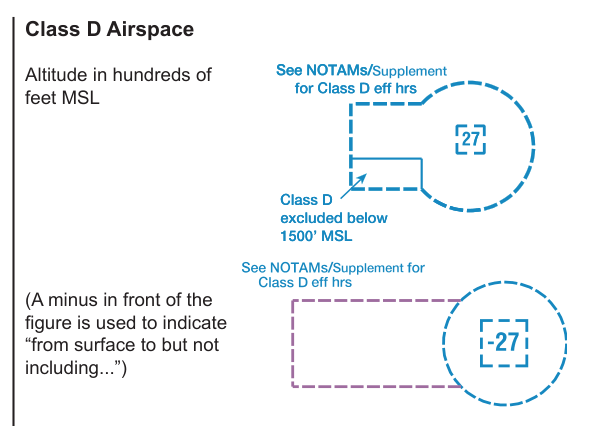
Refer to the figure. The second Class D example shows the bracketed altitude as [-27] instead of [27]. What does the minus sign placed before the number mean?
- The ceiling was lowered by 2,700 feet from its normally published altitude
- Class D airspace extends from the surface up to, but not including, 2,700 feet MSLCorrect
- Class D airspace is suspended below 2,700 feet MSL during the published part-time hours
Why: The figure's own caption states that a minus sign in front of the bracketed figure is used to indicate "from surface to but not including," so [-27] marks Class D extending from the surface up to but not including 2,700 feet MSL. The guide assigns no meaning involving a lowered ceiling or part-time suspension to the minus sign; those are invented readings of a symbol that the caption defines precisely. Primary reference: Aeronautical Chart User's Guide, edition 2026-07-09, Class D Airspace legend, p. 27.
Question 21
An individual designs and modifies a small unmanned aircraft, rather than producing it commercially, and submits a declaration of compliance. Under 14 CFR 107.165(a)(2)(ii), for how long must that person retain the supporting compliance information?
- 2 years after the person submitted the declaration of complianceCorrect
- 2 years after cessation of production, the period a producer gets
- 5 years after the aircraft's first flight
Why: Section 107.165(a)(2)(ii) sets a different starting point for a person who designs or modifies a small unmanned aircraft rather than producing it: retention runs for 2 years after that person submitted the declaration of compliance, not 2 years after a cessation of production (which applies only to a producer under (a)(2)(i)) and not a 5-year first-flight rule, which the section does not contain. Primary reference: 14 CFR 107.165(a)(2)(ii), Record retention.
Question 22
A sectional chart shows a dashed magenta line around an airport with no operating control tower. What does this symbol depict?
- Class D airspace with the control tower only temporarily closed for the evening
- The boundary of a military operations area established nearby
- Surface Class E airspace designated for the airportCorrect
Why: The Chart User's Guide states that Class E Surface (SFC) Airspace is symbolized with a magenta dashed line, which is how controlled airspace is extended to the surface at airports without a control tower. Class D is instead shown with a dashed blue line regardless of tower status, and a military operations area uses the separate special use airspace boundary symbol, so neither distractor matches a dashed magenta line. Primary reference: Aeronautical Chart User's Guide, edition 2026-07-09, Class E surface airspace depiction, p. 17.
Question 23
A remote pilot in command wants to operate a small unmanned aircraft from a moving pickup truck to inspect a pipeline over a sparsely populated area, without transporting anyone else's property for compensation. Under 14 CFR 107.25(b), is this permitted?
- Yes, but only if the vehicle remains under 10 mph
- Yes, operation from a moving land vehicle is allowed over a sparsely populated area when not transporting another's property for compensation or hireCorrect
- No, operation from any moving land vehicle is always prohibited, a superseded figure
Why: Permits operation from a moving land or water-borne vehicle only over a sparsely populated area and only when not transporting another person's property for compensation or hire. The other listed options restate adjacent or superseded rules and do not match the cited text, so they are incorrect under the current regulation. Primary reference: 14 CFR 107.25(b), Operation from a moving vehicle or aircraft. Cross-reference: AC 107-2A, paragraph 5.14, p. 5-12.
Question 24
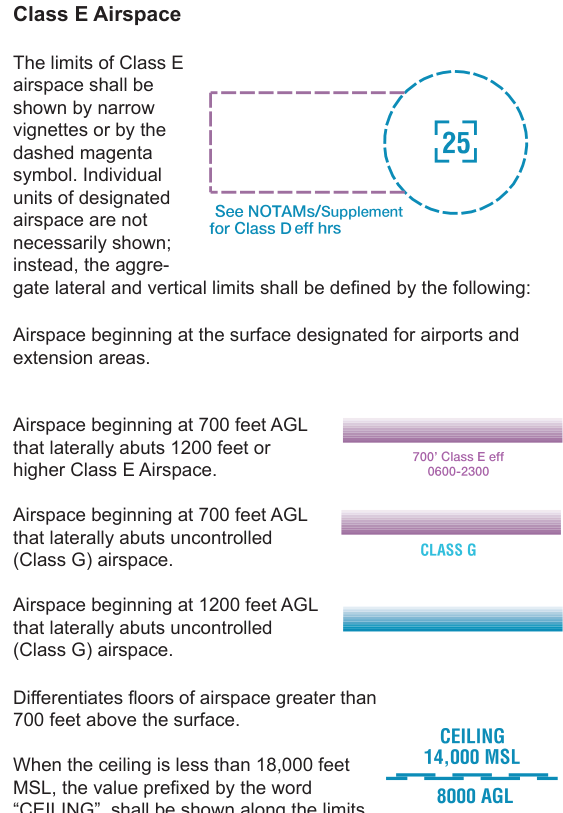
Refer to the figure. A second gradient band in the same legend is blue rather than magenta. What does the blue vignette mean, and does it change the ATC authorization a remote pilot needs under 14 CFR 107.41?
- It marks a temporary flight restriction, which always requires prior ATC authorization under 107.41
- It marks Class E airspace beginning at 700 feet AGL and extending down to the surface, which always requires prior ATC authorization under 107.41
- It marks Class E airspace at 1,200 feet AGL abutting Class G; 107.41 authorization is not triggered, since this is not an airport's Class E surface areaCorrect
Why: The guide defines the blue vignette as airspace beginning at 1,200 feet AGL that laterally abuts uncontrolled Class G airspace, a floor higher than the magenta vignette's 700 feet. 14 CFR 107.41 only requires prior ATC authorization in Class B, C, D, or the surface area of Class E designated for an airport, none of which this elevated floor represents, so the first distractor both mislabels the altitude and misapplies the authorization rule, and the second distractor invents a TFR reading the vignette does not carry. Primary reference: 14 CFR 107.41, Operation in certain airspace. Cross-reference: Aeronautical Chart User's Guide, edition 2026-07-09, Class E Airspace legend, p. 27.
Question 25
Under 14 CFR 107.130(b)(1), what must the label indicating a small unmanned aircraft's eligibility for Category 3 operations be?
- In English, legible, prominent, and permanently affixed to the aircraftCorrect
- Printed only inside the aircraft's paper user manual, never on the aircraft itself
- Applied only after the very first flight conducted over a non-participating person
Why: Section 107.130(b)(1) requires the Category 3 eligibility label to be in English and to be legible, prominent, and permanently affixed to the small unmanned aircraft, mirroring the Category 2 standard in 107.120(b)(1). A label placed only in the user manual, or applied only after an over-people flight has already occurred, does not satisfy this condition. Primary reference: 14 CFR 107.130(b)(1), Category 3 operations: Eligibility of small unmanned aircraft and other applicant requirements.
Want unlimited practice like this, with full mock exams?
Start free →